Relocation & Changing Vegetation - Creating Art In A New Environment

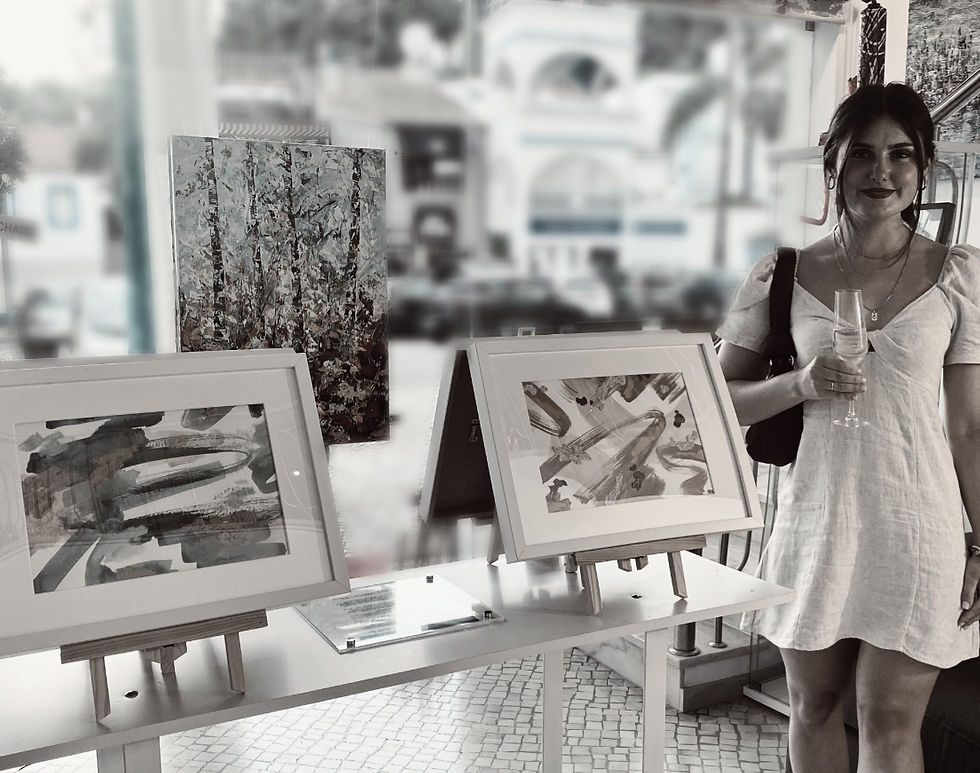
Life in a new country. As you may or may not know, I recently made the decision to relocate to Portugal. This has come with an abundance of new inspiration, influences and opportunity to create location-based works that reflect the beautiful surroundings of the Algarve.
As I have often emphasised, but would like to revive for anyone who isn't aware, I take most of my inspiration from organic matter, found in the natural landscape. I use this to create fluid lines and shapes that are somewhat contrasting, bringing them together through juxtaposed paint languages and layers (this can be through contrasts like rough and smooth, matte and gloss, light and dark and so forth). To achieve this, I carefully position each component in a systematic way so that the elements comes together as one finished piece.
This process has continued in my new location, yet has manifested into deeper emphasis on colour and shape. I have found that I am now considering new ways to use the landscape for every aspect of my work, rather than drawing on some elements and embellishing others. The main areas that I am now delving into are colour, texture, shape and contrast.
COLOUR
I'm really enjoying drawing colour choices from the natural landscape, especially being in a completely new environment by the coast, in a warmer climate. This means that the vegetation is excitingly different to the UK, bringing new plants and, therefore, colour. I particularly love the contrast between vibrant and muted colours. One favourite would be the Ficus Carica (or fig trees). The deep purple contrasted with the dusted green is a dream (as well as their distinctive smell, which for me is almost the symbolic smell of Portugal).
Another beautiful, yet abundant plant that provides perfect combination similar to that of Ficus Carica is Olea europaea (Olive plant). Deep green leaves contrasted with soft muted olives or shiny, deep purple to black fruits, offer an excellent palette to work from.
Moving away from vegetation and looking towards the landscape, Ive been playing with is the changing colours of the sky in relation to the sea. Being here in winter, which is another new experience for me, is really inspiring as the skies offer much more diversity to that in summer. Cloud formations and stormy skies are bringing exciting variations to everything I have known before.
I can't move on from colour without mentioning the most famous aspect of the Algarvian landscape- anyone who's been here should already know the answer to this! The rock formations that are created by the sea constantly change the coastline, providing life and story to the landscape. Their colour, texture and shape (which I'm going to discuss more in the next sections) offer something cannot be rivalled.
TEXTURE
Texture plays an important role in my art. It elevates the creation of juxtaposition that I aim to achieve in my artworks. The most prominent texture change in this new location compared to the UK is the stone. The pavements, walls and buildings have a much more organic approach to them, like that you would see in dry stone walls up in the north of England and Scotland, but this labour is still used as the chosen design rather than relying on fancy technologies that don't necessarily stand the test of time. So what material is used to make this infrastructure?
The famous Mesozoic limestone cliffs provide a resource for building in this area. They offer amazing natural shapes with a rough texture that I look for when aiming to achieve textures in my art. This is made through many, many years of sedimentation, and leaves formations creating caves and small bays. Both in a natural and utilised environment, this material is beautiful inspiration for my work.
SHAPE
Following on from the last section, I wanted to discuss shape in relation to the caves and coves that have been formed over thousands of years, and, are ever changing. The Algarve has an amazing number of beaches (88 blue flag beaches, to be precise) and many more hidden gems. The coastal walks have inspired me as they move in and out, up and down in a free, snake like way that fits perfectly with the top layer of my artworks, where I previously stuck to the black ink running across the page. I have now begun to use lighter shades of colour, in movements that represent the coastal pathway- and I would like to more accurately use in each of my pieces, and therefore each work could relate to a section of the landscape.
CONTRAST
I think the greatest contrast I have experienced is the weather. Despite being in the winter season, the days are much more pleasant than the dark, gloomy, and not to forget rainy, days in Manchester. This has been to my advantage as I’m able to get my daily dose of Vitamin D to help with my motivation and energy levels. Other contrasts I am exploring and therefore transferring to my work could be sun and storm, wet and dry, smooth and rough and so on. These can be used when choosing my materials, such as making me paint thicker or more wet, like watercolour.
All of these experiences have offered an amazing opportunity to think about my work in a new way, and now instead of producing work that subconsciously represents the organic landscape, it has a sense of purpose and place. I am also looking into what is the best way to work here, as canvas is seemingly a better choice of material than paper and frames.
I hope this has offered an insight into my motivations whilst working here in Portugal, a bit of information about the landscape and probably a very oversold article of the Algarve.


Comments